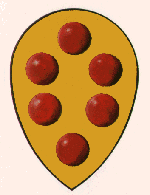
The Medici Family
The Medici were possibly the richest family in Italy. In the 13th Century the family began to gain wealth. At the end of the thirteenth century, the family's wealth increased when one of the members of the family served as gonfalero (bearer of a high ceremonial office).
In the fourteenth century their wealth increased again.
Savestro de Medici led people in revolt against the ciompi (small artistanate) and later he became so popular that he became defacto dictator of Florence. Then in 1383 his wealth decreased when he was banished.
Giovanni Bicci de Medici regained family power by making the family the richest family in Italy, possibly Europe. The growth in political power also increased when he became gonfalero in 1421.
Giovanni's son, Cosimo de Medici, was to be the real founder of the family's fortune. In 1434, Cosimo controlled the government in Florence. For the sixty years Cosimo ruled Florence but he had no official title. He ruled in the early 15th Century when he ran for office. He held office in Florence's highest magistry and at the same time he managed interests in banking, trade, and industry. Later on in a political battle with another powerful family called the Albizzi family, Cosimo lost and was banished. But since a lot of people supported him, he was recalled and the Albizzi family was banished in return.
Cosimo had done a lot for the city of Florence. He had spent lots of his money on his city and supported artists and sculptors. Churches were built and many large libraries were produced with the books he collected. After Cosimo had died he won the title of Pater Palrige (father of his country).
Cosimo had two sons and while his first son, Pier, ruled things kind of slipped. Then once again their wealth increased because of his other powerful son named Lorenzo.
Lorenzo was a poet, statsman, politician, banker, patron of artists, writer, philosopher, and he played an important role in Italian politics. He had spent some of his time writing poetry and carnival songs. Although he didn't occupy any official post, he did a lot of good things for the people. An example of one of his qualities was he paid for artists' education and supplied them with homes by buying their work. He was truly a man of the Renaissance.
Following the rule of Piero came the tyranny of his sons, Lorenzo and Giuliano. Giuliano died young (1453-78). Lorenzo, who became known as Lorenzo the Magnificent, did not have the economic ability of his predecessors, and was a tyrant and a hedonist. But he also patronized the arts, and presided over Florence's Golden Age. Such noted artists as Boticelli and Michaelangelo flourished during this height of the Renaissance. Lorenzo's political ineptitude would hurt him in foreign affairs, and his tyranny deprived him of what had always been the Mediciís strongest base of support: popular acceptance of their rule.
ACCOMPLISHMENTS
One of the many accomplishments that the Medici family offered in the Renaissance period was when their wealth had first begun. One member became gonfaler standard bearer. From then on the word success fitted the Medici family well. While they ruled the city of Florence they did many incredible acts, such as spending money on their city, and making it the most powerful state in Italy. They also made it the world's most beautiful city. It became the cultural center of Europe and was known as an art center and cradle of New Humanism. They also spent some of their wealth on having the largest library in Europe; they brought in many Greek sources. They founded the Platonic Academy and supported artists by feeding them, educating them, and providing them with the necessities. Some of those artists were Donatello, Michelangelo, and Raphael. The family also did a lot of charitable acts such as cultivating literature and the arts. The Medici family was very helpful.
IMPACT
The Medici family members were very interested in the rebirth of learning in Europe and under their patronage the Renaissance flourished.
 [Close]